JDM Lure Technique from Japan #20: BOTTOMUP Scooper Frog Just Below the Surface with Yohei Takanashi
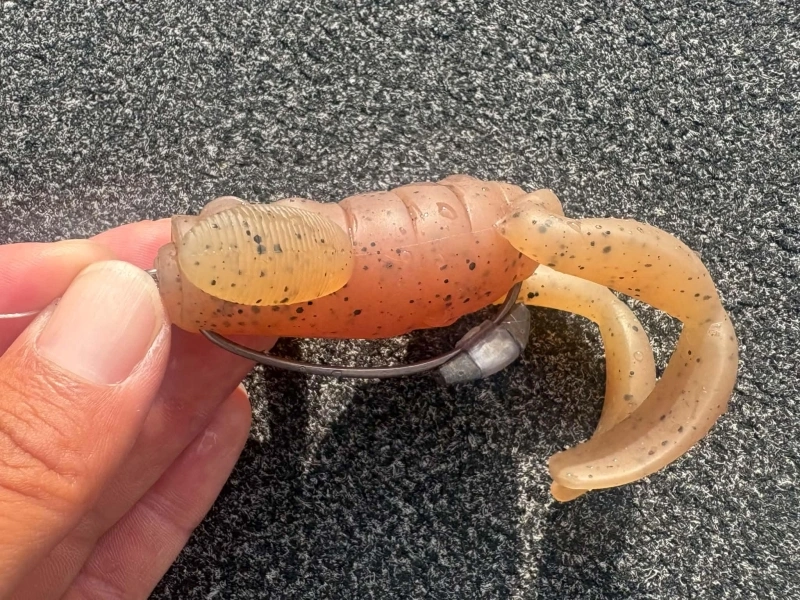
The BOTTOMUP Scooper Frog has become one of the most versatile soft baits in modern Japanese bass fishing.
Originally well known for its unusual frog-like shape and kicking action, Japanese anglers now use it in many different ways. It can be fished weightless as a topwater bait, used as a jig trailer, or combined with football heads and other weighted rigs.
This time, Lake Hibara guide Yohei Takanashi showed us another interesting way to fish the Scooper Frog: just below the surface with the VARIVAS Hook Set Sinker “OMOSHI!”
This technique also connects directly with the product we introduced in our previous article. OMOSHI! is a small weight that can be attached directly to a hook, and unlike a conventional weighted hook, the angler can decide exactly where the weight should be positioned.
Why Fish the Scooper Frog Below the Surface?
The Scooper Frog is normally very effective as a weightless topwater bait.
However, topwater fishing becomes more difficult when wind and waves disturb the surface.
According to Yohei, moving the same bait only slightly below the surface can make a big difference.
This presentation is especially useful around flooded bushes and floating cover, where bass may still be willing to attack near the surface even when conditions are too rough for a conventional topwater presentation.
Instead of forcing the fish to break the surface, the Scooper Frog passes just underneath it.
The Retrieve Is Extremely Simple
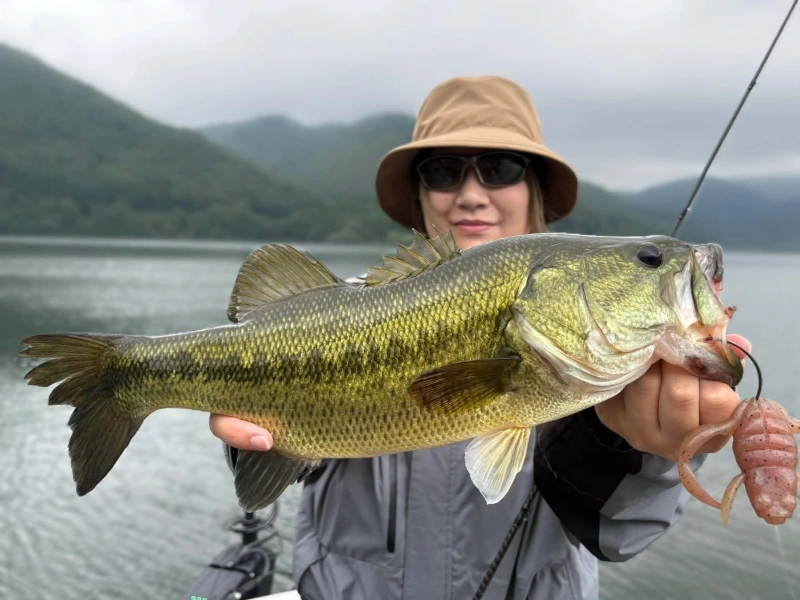
The key is not to move the bait too far.
Yohei keeps the rod tip low and makes a continuous series of very light twitches.
With each twitch, the Scooper Frog’s legs move aggressively, but the bait itself travels only a short distance.
This allows the lure to remain in the strike zone for a long time.
Rather than quickly swimming through an area, the bait almost stays in place while producing a slow, rolling and kicking action just below the surface.
That combination of strong action and very little forward movement is one of the most interesting features of this technique.
Why the Weight Is Positioned Toward the Rear
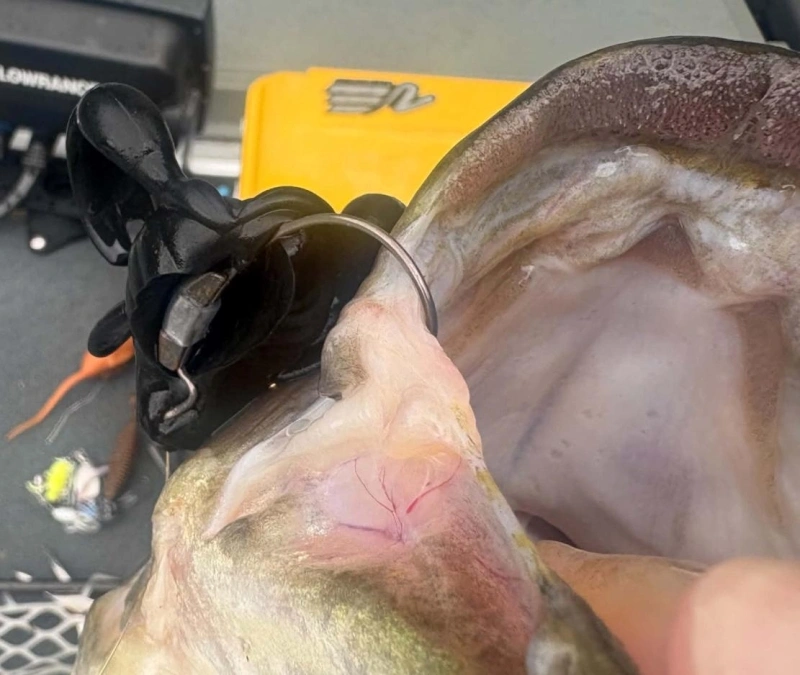
The position of the OMOSHI! weight is also important.
Yohei prefers to place it toward the rear half of the hook.
There is a reason for this.
With the weight toward the rear, the bait can move slightly up and down as it is twitched. This creates a less stable, more irregular action.
When the weight is positioned too far forward, the lure becomes more stable and loses some of this movement.
This is exactly where the adjustable position of OMOSHI! becomes useful.
Instead of being limited by the fixed weight location of a conventional weighted hook, the angler can tune the balance of the bait.
PE or Fluorocarbon Changes the Depth
Yohei also changes the line depending on the depth he wants to fish.
With PE braid, the Scooper Frog stays very close to the surface.
With fluorocarbon, the line sinks and allows the bait to work slightly deeper.
So even with the same lure and same weight, the running depth can be adjusted simply by changing line type.
Yohei Takanashi’s Setup
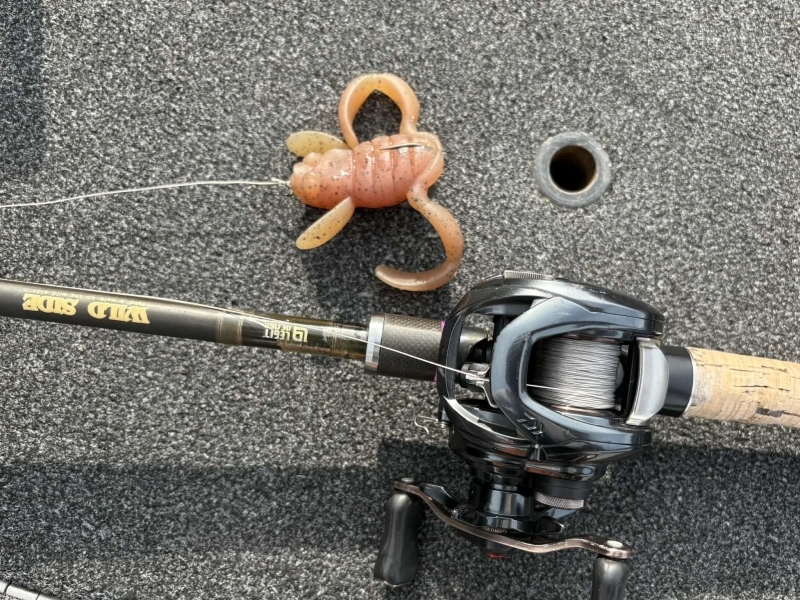
Yohei’s main setup for the Scooper Frog Magnum is:
Wild Side WSC69MH
PE #4
BOTTOMUP Scooper Frog Magnum
VARIVAS Hook Set Sinker “OMOSHI!” 2.7g
For the smaller Scooper Frog Daddy, he uses the 1.8g OMOSHI!.
However, even 1.8g can sometimes be slightly too heavy.
In that case, he actually trims the sinker little by little until the bait achieves the exact balance and action he wants.
This kind of fine adjustment is very typical of Japanese bass fishing.
The idea is not simply to choose a lure and fish it exactly as it comes from the package.
Small changes in weight, balance, line, and retrieve can completely change how a bait behaves.
A New Way to Look at the Scooper Frog
The Scooper Frog is already known as a very versatile bait, but this technique adds another option.
When a weightless topwater presentation becomes difficult because of wind or waves, adding a small amount of weight and moving the bait just below the surface can keep the same aggressive kicking action while making it easier for bass to attack.
And because the OMOSHI! weight can be positioned anywhere on the hook, anglers can fine-tune the lure’s balance instead of simply adding weight.
It is a small modification, but it creates a completely different presentation.
That is exactly the kind of detail we want to introduce in our JDM Lure Technique from Japan series.
JDM Lure Technique from Japan 2026-08-22 15:24